Enabling Secure Sockets Layer (SSL) for the Network Device Enrollment Service (NDES).

In the default configuration, the Network Device Enrollment Service (NDES) only accepts unencrypted connections via HTTP. It is recommended that at least the NDES administration web page be configured for HTTP over TLS (HTTPS) to make it difficult to capture network traffic. The following is a guide.

For a closer look at the need to use SSL, see the article "Should HTTPS be used for the Network Device Enrollment Service (NDES)?„.

Continue reading „Secure Sockets Layer (SSL) für den Registrierungsdienst für Netzwerkgeräte (NDES) aktivieren“

Using custom Registration Authority (RA) certificate templates for the Network Device Enrollment Service (NDES).

The Network Device Enrollment Service (NDES) uses two certificate templates for its internal function to make it act as a Registration Authority (RA). These are published during role configuration of the NDES service on the configured certificate authority and certificates are requested:

  • CEP Encryption
  • Exchange Enrollment Agent (Offline Request)

These certificate templates are standard templates from the Windows 2000 world (version 1 templates), i.e. they cannot be edited. In addition, the Exchange Enrollment Agent (Offline Request) template is marked as a user template, i.e. during NDES role configuration the certificate is requested in the context of the installing user and then imported into the machine store. At the latest when the certificates are to be renewed after two years, things get complicated here.

It is therefore a good idea to use your own certificate templates for NDES. These can be adapted in terms of their key length, for example. The use of hardware security modules (HSM) is also possible in this way. Even automatic renewal can be configured.

Continue reading „Eigene Registration Authority (RA) Zertifikatvorlagen für den Registrierungsdienst für Netzwerkgeräte (NDES) verwenden“

Domain controller does not check extended key usage on smart card login

Anyone who wants to use the smartcard logon function in their company would be well advised to ensure that their certification authority has the strongest possible security hardening. This includes some essential measures:

  • Removing all unnecessary certification authority certificates from the NTAuthCertificates object in Active Directory: Each certification authority located in this store is authorized to issue smartcard logon certificates in Active Directory for the complete forest.
  • Use qualified subordinationRestricting the certification authority certificates so that they are only trusted for the extended key usages actually issued. In the event of a compromise of the certification authority, the damage is then limited to these extended key usages. The "Smart Card Logon" Extended Key Usage would then only be present in the certification authority certificate of the certification authority that actually issues such certificates.

What is interesting about these thoughts, however, is that the domain controllers do not check the extended key usages at all when logging in via smartcard.

Continue reading „Domänencontroller überprüfen erweiterte Schlüsselverwendung (Extended Key Usage) bei Smartcard Anmeldung nicht“

What requirements must be met on the infrastructure side for smartcard logins to be possible?

In order for a smart card login to be successful, some requirements must be met in the Active Directory environment:

Continue reading „Welche Voraussetzungen müssen auf Infrastruktur-Seite erfüllt sein, damit Smartcard-Anmeldungen möglich sind?“

Removing ADCS-specific extensions from certificates

When using Active Directory Certificates, it is noticeable that there are certain extensions in the certificates of the certification authorities and the certificates they issue that are not defined in the relevant RFCs and are specific to AD CS.

Continue reading „Entfernen der ADCS-spezifischen Erweiterungen aus Zertifikaten“

Firewall rules required for Active Directory Certificate Services

Implementing an Active Directory integrated certification authority often requires planning the firewall rules to be created on the network. The following is a list of the required firewall rules and any pitfalls.

Continue reading „Benötigte Firewallregeln für Active Directory Certificate Services“

Description of the EDITF_ADDOLDKEYUSAGE flag

When installing a subordinate certificate authority, you may encounter the following behavior:

  • One requests a Key Usage extension that is marked as critical, for example, or does not include DigitalSignature.
  • However, the certificate issued by the parent certificate authority includes DigitalSignature, and the Key Usage extension is marked as non-critical.
  • The parent certification authority is a standalone certification authority, i.e. without Active Directory integration.
Continue reading „Beschreibung des Flags EDITF_ADDOLDKEYUSAGE“

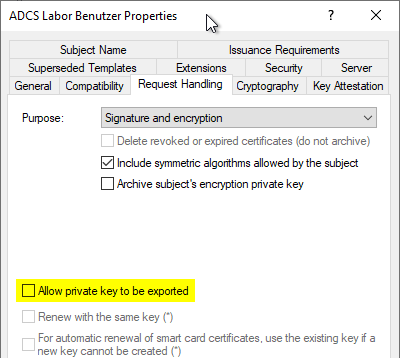
How secure is the "Allow private key to be exported" setting in the certificate templates?

PKI administrators often assume that the option in the certificate template to not allow the private key for export is mandatory.

However, that is not the case.

Continue reading „Wie sicher ist die Einstellung „Allow private key to be exported“ in den Zertifikatvorlagen?“

Overview of the different generations of domain controller certificates

Over the generations of Windows operating systems, various certificate templates for domain controllers have been established. In a current Active Directory directory service, one will find three different templates for this purpose.

  • Domain controller
  • Domain Controller Authentication
  • Kerberos Authentication

Below is a description of each template and a recommendation for configuring domain controller certificate templates.

Continue reading „Übersicht über die verschiedenen Generationen von Domänencontroller-Zertifikaten“

certutil -dcinfo fails with error message "KDC certificates: Cannot find object or property. 0x80092004 (-2146885628 CRYPT_E_NOT_FOUND)"

Assume the following scenario:

  • Domain controllers have certificates for LDAP over SSL.
  • The certificates do not include the Extended Key Usage "Smart Card Logon" or "Kerberos Authentication".
  • If you run certutil -dcinfo, the command reports the following error message:
0 KDC certificates for DC01
No KDC Certificate in MY store
KDC certificates: Cannot find object or property. 0x80092004 (-2146885628 CRYPT_E_NOT_FOUND)
Continue reading „certutil -dcinfo schlägt fehl mit Fehlermeldung „KDC certificates: Cannot find object or property. 0x80092004 (-2146885628 CRYPT_E_NOT_FOUND)““

Manual application for a domain controller certificate

There are cases where you cannot or do not want to obtain domain controller certificates from a certification authority in your own Active Directory forest.

In this case, the use of certificate templates is not possible, and one must manually create a Certificate Signing Request (CSR).

Continue reading „Manuelle Beantragung eines Domänencontroller-Zertifikats“

Requesting a certificate for domain controller fails with error message "The RPC server is unavailable. 0x800706ba (WIN32: 1722 RPC_SERVER_UNAVAILABLE)".

Here's the scenario:

  • Requesting a certificate for a domain controller fails.
  • The certificate request is logged in the failed requests section of the certification authority. The error message reads:
The RPC server is unavailable. 0x800706ba (WIN32: 1722 RPC_S_SERVER_UNAVAILABLE)
Continue reading „Die Beantragung eines Zertifikats für Domänencontroller schlägt fehl mit Fehlermeldung „The RPC server is unavailable. 0x800706ba (WIN32: 1722 RPC_S_SERVER_UNAVAILABLE)““
en_USEnglish