
Include the issuance policies for Trusted Platform (TPM) Key Attestation in a certification authority certificate.

If you install an issuing CA and do not explicitly request an issuance policy, the resulting CA certificate does not contain an issuance policy.
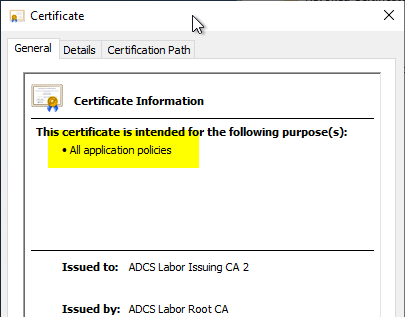
If you want to include the issuance policies for Trusted Platform (TPM) Key Attestation in the certification authority certificate, you must proceed as follows.

Continue reading „Die Ausstellungsrichtlinien (Issuance Policies) für Trusted Platform (TPM) Key Attestation in ein Zertifizierungsstellen-Zertifikat aufnehmen“

Determine and export a Trusted Platform Module (TPM) Endorsement Certificate

If you want to use the Trusted Platform Module (TPM) key attestation, you have the option of attesting the TPM via the endorsement certificate (EkCert), among other things. The following describes how to obtain this information.

Continue reading „Ermitteln und Exportieren eines Trusted Platform Module (TPM) Endorsement Zertifikats“

Determine the checksum (hash) of a Trusted Platform (TPM) Endorsement Key

If you want to use the Trusted Platform Module (TPM) key attestation, you have the option of attesting the TPM via the endorsement key (EkPub), among other things. The following describes how to obtain this information.

Continue reading „Die Prüfsumme (Hash) eines Trusted Platform (TPM) Endorsement Key ermitteln“

Frequently Used Extended Key Usages and Issuance Policies

The following is a list of commonly used extended key usage and issuance policies that are used repeatedly in practice to restrict certificate authority certificates.

Continue reading „Häufig verwendete erweiterte Schlüsselverwendungen (Extended Key Usages) und Ausstellungsrichtlinien (Issuance Policies)“

Logon via smartcard fails with error message "The revocation status of the authentication certificate could not be determined."

Assume the following scenario:

  • A user has a Smartcard Logon certificate and logs on to the Active Directory domain with it.
  • The login fails. The following error message is returned to the user's computer:
The revocation status of the authentication certificate could not be determined.
Continue reading „Die Anmeldung via Smartcard schlägt fehl mit Fehlermeldung „The revocation status of the authentication certificate could not be determined.““

Renew the Registration Authority (RA) certificates for the Network Device Enrollment Service (NDES).

Once NDES has been in operation for some time (typically two years), one is faced with the challenge of renewing the Registration Authority (RA) certificates. Unfortunately, this process is not necessarily solved intuitively and is therefore described in more detail in this article.

Continue reading „Die Registration Authority (RA) Zertifikate für den Registrierungsdienst für Netzwerkgeräte (NDES) erneuern“

The Network Device Enrollment Service (NDES) logs the error message "The Network Device Enrollment Service cannot retrieve one of its required certificates (0x80070057). The parameter is incorrect."

Assume the following scenario:

  • An NDES server is configured on the network.
  • HTTP error 500 (Internal Server Error) is reported when accessing the NDES application web page (mscep) and the NDES administration web page (certsrv/mscep_admin).
  • The events no. 2 and 10 stored in the application event log:
The Network Device Enrollment Service cannot be started (0x80070057). The parameter is incorrect.
The Network Device Enrollment Service cannot retrieve one of its required certificates (0x80070057). The parameter is incorrect.
Continue reading „Der Registrierungsdienst für Netzwerkgeräte (NDES) protokolliert die Fehlermeldung „The Network Device Enrollment Service cannot retrieve one of its required certificates (0x80070057). The parameter is incorrect.““

Creating a virtual smart card in a Hyper-V guest system

For test environments, it is often helpful to be able to work with smartcards. Below is a brief guide on how to set up a virtual smartcard in a Hyper-V guest using a virtualized Trusted Platform Module (TPM).

Continue reading „Erstellen einer virtuellen Smartcard in einem Hyper-V Gastsystem“

Domain Controller Certificate Templates and Smartcard Logon

In order for domain controllers to process smart card logins, they need certificates that provide this function.

Continue reading „Domänencontroller-Zertifikatvorlagen und Smartcard Anmeldung“

(Re-)Installing the Microsoft Standard Certificate Templates

There may be cases where it is necessary to install the standard Microsoft certificate templates before installing the first Active Directory integrated certificate authority (Enterprise Certification Authority), or to reinstall the templates, for example because they have been corrupted or otherwise modified.

Continue reading „(Neu-) Installieren der Microsoft Standard Zertifikatvorlagen“

Attack vector on Active Directory directory service via smartcard logon mechanism

In simple terms, public key cryptography can be reduced to the assumption that the private part of each key pair is known only to its owner.

A certification authority is responsible for the correct identification of users, computers or resources. Its issued certificates are therefore granted a trust status because all participants assume that their private key is known only to it.

If an attacker succeeds in gaining knowledge of a certification authority's private key, or at least Perform signatures using the private key, the integrity of the certification authority is no longer guaranteed.

Continue reading „Angriffsvektor auf den Active Directory Verzeichnisdienst über den Smartcard Logon Mechanismus“

Basics: Restricting Extended Key Usage (EKU) in Certification Authority Certificates

A useful hardening measure for Certification Authorities is to restrict the Certification Authority certificates so that they are only used for the actually issued extended key usage (Extended Key Usage) becomes familiar.

In the event of a compromise of the certification authority, the damage is then (at least) limited to the defined extended key usages.

The Smart Card Logon Extended Key Usage, which is of interest for many attacks (in conjunction with the certification authority's membership in NTAuthCertificates) would then only be present in the certification authority certificate of the certification authority that actually issues such certificates.

Continue reading „Grundlagen: Einschränken der erweiterten Schlüsselverwendung (Extended Key Usage, EKU) in Zertifizierungsstellen-Zertifikaten“

What key lengths should be used for certificate authorities and certificates?

When planning a public key infrastructure, the question naturally arises as to which key lengths should be selected for certification authority and end certificates.

Continue reading „Welche Schlüssellängen sollten für Zertifizierungsstellen und Zertifikate verwendet werden?“

Generating a RFC 2818 compliant certificate request for SSL certificates

Google is a major player with the Chromium project and products based on it such as Google Chrome and Microsoft Edge have moved to implement the RFC 2818 and to no longer trust certificates that no longer fulfill the RFC.

For us, the following sentence is of great explosiveness:

If a subjectAltName extension of type dNSName is present, that MUST be used as the identity. Otherwise, the (most specific) Common Name field in the Subject field of the certificate MUST be used. Although the use of the Common Name is existing practice, it is deprecated and Certification Authorities are encouraged to use the dNSName instead

https://tools.ietf.org/html/rfc2818
Continue reading „Erzeugen einer RFC 2818 konformen Zertifikatanforderung für SSL Zertifikate“

Configure Device Template for Network Device Enrollment Service (NDES)

By default, the Network Device Enrollment Service (NDES) requests certificates from the "IPsec (Offline Request)" template. This certificate template is from Windows 2000 times and cannot be edited. Therefore, it is recommended to change the default settings and use your own certificate templates that serve your personal requirements.

Continue reading „Gerätevorlage für den Registrierungsdienst für Netzwerkgeräte (NDES) konfigurieren“
en_USEnglish