
Details of the event with ID 19 of the source Microsoft-Windows-Kerberos-Key-Distribution-Center
| Event Source: | Microsoft-Windows-Kerberos-Key-Distribution-Center |
| Event ID: | 19 (0x80000013) |
| Event log: | System |
| Event type: | Warning |
| Event text (English): | This event indicates an attempt was made to use smartcard logon, but the KDC is unable to use the PKINIT protocol because it is missing a suitable certificate. |
| Event text (German): | Dieses Ereignis zeigt an, dass ein Versuch unternommen wurde, die Smartcard-Anmeldung zu verwenden, aber der KDC kann das PKINIT-Protokoll nicht verwenden, weil ein geeignetes Zertifikat fehlt. |
Example events
This event indicates an attempt was made to use smartcard logon, but the KDC is unable to use the PKINIT protocol because it is missing a suitable certificate.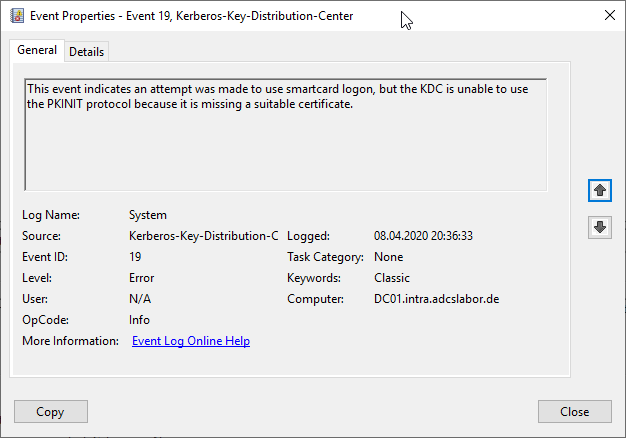
Do you know TameMyCerts? TameMyCerts is an add-on for the Microsoft certification authority (Active Directory Certificate Services). It extends the function of the certification authority and enables the application of rule sets to realize the secure automation of certificate issuance. TameMyCerts is unique in the Microsoft ecosystem, has already proven itself in countless companies around the world and is available under a free license. It can be downloaded via GitHub and used free of charge. Professional maintenance is also offered.
Description
This message occurs when a logon is performed via smart card, but the domain controller's certificate does not have any of the required Extended Key Usages (EKU) .
The event occurs together with the event with ID 29 .
This is the case, for example, when a customized security-hardened certificate template is used for the domain controllers, which does not allow smart card logon.
See also article "Smart card logon fails with error message "Signing in with a security device isn't supported for your account." ".
Can also occur when the domain controllers cannot check the revocation status of their own certificates, for example, because the CRL distribution points (CDP) are offline.
More information
- For more information regarding the default certificate templates for domain controllers, see the article "Overview of the different generations of domain controller certificates ".
- For more information regarding smart card logon, see the article "Domain Controller Certificate Templates and Smart Card Logon ".
- For the correct configuration of a certificate template for domain controllers, see the article "Configuring a Certificate Template for Domain Controllers ".
Security assessment
The security assessment is based on the three dimensions of confidentiality, integrity and availability.
If security-hardened certificate templates are used which do not allow logon via smart card, this event may indicate an unauthorized logon attempt as well as compromise of a certification authority. In this case, it would be rated as "critical" in terms of integrity.
For a description of the underlying problem, see the article "Attack vector on the Active Directory directory service via the smart card logon mechanism ".
External sources
- Event ID 19 — KDC Certificate Availability (Microsoft)