
There may be cases where it is necessary to install the standard Microsoft certificate templates before installing the first Active Directory integrated certificate authority (Enterprise Certification Authority), or to reinstall the templates, for example because they have been corrupted or otherwise modified.
The following standard certificate templates are defined:
| Object name | Display name (English) | Display Name (German) |
|---|---|---|
| Administrator | Administrator | Administrator |
| CA | Root Certification Authority | Master Certification Authority |
| CAExchange | CA Exchange | Certification Authority exchange |
| CEPEncryption | CEP Encryption | CEP Encryption |
| ClientAuth | Authenticated Session | Authenticated Session |
| CodeSigning | Code Signing | Code signature |
| CrossCA | Cross Certification Authority | Cross-Sector Certification Body |
| CTLSigning | Trust List Signing | Trusted List Signature |
| DirectoryEmailReplication | Directory Email Replication | Directory Email Replication |
| DomainController | Domain controller | Domain controller |
| DomainControllerAuthentication | Domain Controller Authentication | Domain Controller Authentication |
| EFS | Basic EFS | Basic EFS |
| EFSRecovery | EFS Recovery Agent | EFS Recovery Agent |
| EnrollmentAgent | Enrollment Agent | Registration Agent |
| EnrollmentAgentOffline | Exchange Enrollment Agent (Offline request) | Exchange Enrollment Agent (Offline Request) |
| ExchangeUser | Exchange User | Exchange users |
| ExchangeUserSignature | Exchange User Signature | |
| IPSECIntermediateOffline | IPSec (Offline Request) | IPSec (Offline Request) |
| IPSECIntermediateOnline | IPSec | IPSec |
| KerberosAuthentication | Kerberos Authentication | Kerberos authentication |
| KeyRecoveryAgent | Key Recovery Agent | Key Recovery Agent |
| Machine | Computer | Computer |
| MachineEnrollmentAgent | Enrollment Agent (Computer) | Registration Agent (Computer) |
| OCSPResponseSigning | OCSP Response Signing | OCSP Response Signature |
| OfflineRouter | Router (Offline Request) | Router (Offline Request) |
| RASandIASServer | RAS and IAS Server | RAS and IAS Servers |
| SmartcardLogon | Smartcard Logon | Smartcard login |
| SmartcardUser | Smartcard User | Smart Card Users |
| SubCA | Subordinate Certification Authority | Subordinate Certification Authority |
| User | User | User |
| UserSignature | User Signature Only | User signature only |
| WebServer | Web Server | Web server |
| Workstation | Workstation Authentication | Workstation Authentication |
Implementation
Do you know TameMyCerts? TameMyCerts is an add-on for the Microsoft certification authority (Active Directory Certificate Services). It extends the function of the certification authority and enables the Application of regulationsto realize the secure automation of certificate issuance. TameMyCerts is unique in the Microsoft ecosystem, has already proven itself in countless companies around the world and is available under a free license. It can downloaded via GitHub and can be used free of charge. Professional maintenance is also offered.
Reinstalling the certificate templates means deleting them and then creating them again. To delete them, you must have Enterprise Administrator permissions.
The deletion itself is done with the ADSI editor (adsiedit.msc).
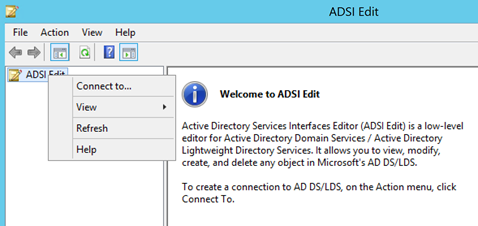
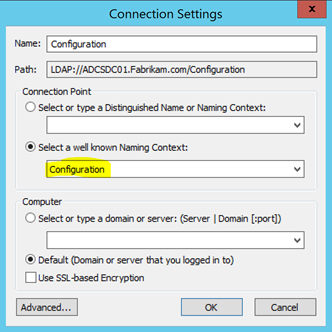
You connect to the configuration partition.
The certificate templates are located at Services – Public Key Services…
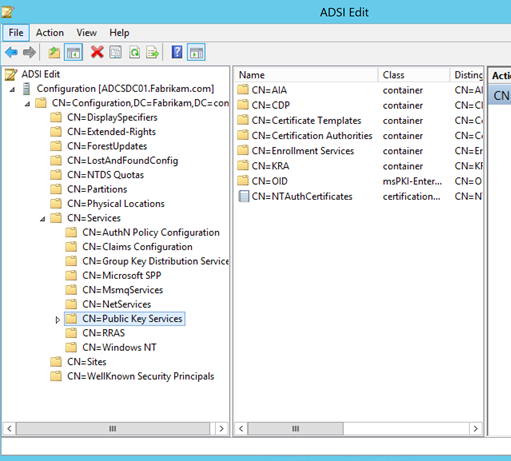
...below CN=Certificate Templates. Here you can select all or individual certificate templates and delete them by right-clicking.
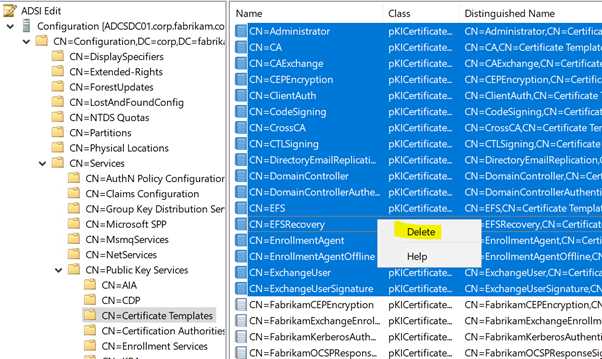
To reinstall the default certificate templates, there is a corresponding certutil command:
certutil -installdefaulttemplates
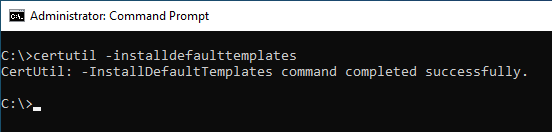
Please note that the command must be executed with Enterprise Administrator privileges.
Related links:
External sources
- How to re-install the default certificate templates? (Microsoft, archive link)
 English
  Deutsch
  Français
Comments are closed.