
PKI Blog

Removing ADCS-specific extensions from certificates

When using Active Directory Certificate Services, it is noticeable that there are certain extensions in the certificates of the certification authorities and the certificates they issue that are not defined in the relevant RFCs and are specific to AD CS.

Continue reading "Removing ADCS-specific extensions from certificates"
Firewall rules required for Active Directory Certificate Services

Implementing an Active Directory integrated certification authority often requires planning the firewall rules to be created on the network. The following is a list of the required firewall rules and any pitfalls.

Continue reading "Firewall rules required for Active Directory Certificate Services"

Description of the EDITF_ADDOLDKEYUSAGE flag

When installing a subordinate certification authority, you may encounter the following behavior:

  • One requests a Key Usage extension that is marked as critical, for example, or does not include DigitalSignature.
  • However, the certificate issued by the parent certification authority includes DigitalSignature, and the Key Usage extension is marked as non-critical.
  • The parent certification authority is a standalone certification authority, i.e. without Active Directory integration.

Continue reading "Description of the EDITF_ADDOLDKEYUSAGE flag"

Installing Remote Server Administration Tools for Active Directory Certificate Services on Windows 10 version 1809 and later

Since Windows 10 version 1809, the Remote Server Administration Tools can no longer be found as a standalone download, but are part of Features on Demand.

Continue reading "Installing Remote Server Administration Tools for Active Directory Certificate Services on Windows 10 version 1809 and later"

How secure is the "Allow private key to be exported" setting in the certificate templates?

PKI administrators often assume that the option in the certificate template not to allow the private key to be exported is binding.

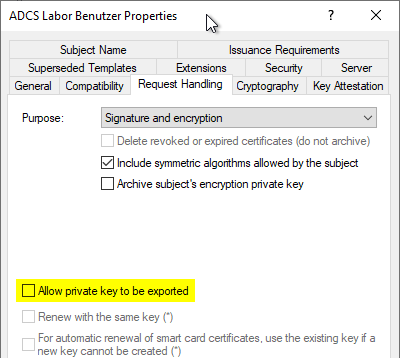
Template properties "ADCS Labor Benutzer", "Request Handling" tab: "Allow private key to be exported" is not enabled (marked in yellow)

However, that is not the case.

Continue reading "How secure is the "Allow private key to be exported" setting in the certificate templates?"

Role configuration for Network Device Enrollment Service (NDES) fails with error message "The RPC server is unavailable. 0x800706ba (WIN32: 1722 RPC_S_SERVER_UNAVAILABLE)"

Assume the following scenario:

  • One installs a Network Device Enrollment Service (NDES) server
  • One has the necessary permissions to install the role (local administrator, enterprise administrator)
  • The role configuration fails with the following error message:
The RPC server is unavailable. 0x800706ba (WIN32: 1722 RPC_S_SERVER_UNAVAILABLE)

Continue reading "Role configuration for Network Device Enrollment Service (NDES) fails with error message "The RPC server is unavailable. 0x800706ba (WIN32: 1722 RPC_S_SERVER_UNAVAILABLE)""

Requesting a certificate via the Certificate Enrollment Web Services fails with error message "Error: The remote endpoint is unable to process the request due to being overloaded. 0x803d0012 (-2143485934 WS_E_ENDPOINT_TOO_BUSY)"

Assume the following scenario:

  • A user requests a certificate.
  • An enrollment policy is configured for this, which points to a Certificate Enrollment Policy Web Service (CEP).
  • The connection to the CEP fails and the user receives the following error message:
Error: The remote endpoint is unable to process the request due to being overloaded. 0x803d0012 (-2143485934 WS_E_ENDPOINT_TOO_BUSY)

Continue reading "Requesting a certificate via the Certificate Enrollment Web Services fails with error message "Error: The remote endpoint is unable to process the request due to being overloaded. 0x803d0012 (-2143485934 WS_E_ENDPOINT_TOO_BUSY)""

Requesting a certificate via the Certificate Enrollment Web Services fails with error message "Error: A message containing a fault was received from the remote endpoint. 0x803d0013 (-2143485933 WS_E_ENDPOINT_FAULT_RECEIVED)"

Assume the following scenario:

  • A user requests a certificate.
  • An enrollment policy is configured for this, which points to a Certificate Enrollment Policy Web Service (CEP).
  • Authentication is done via Kerberos.
  • The certificate is requested from the CEP server itself.
  • The connection to the CEP fails and the user receives the following error message:
Error: A message containing a fault was received from the remote endpoint. 0x803d0013 (-2143485933 WS_E_ENDPOINT_FAULT_RECEIVED)

Continue reading "Requesting a certificate via the Certificate Enrollment Web Services fails with error message "Error: A message containing a fault was received from the remote endpoint. 0x803d0013 (-2143485933 WS_E_ENDPOINT_FAULT_RECEIVED)""

Requesting a certificate via the Certificate Enrollment Web Services fails with error message "Error: The operation timed out 0x80072ee2 (WinHttp: 12002 ERROR_WINHTTP_TIMEOUT)"

Assume the following scenario:

  • A user requests a certificate.
  • An enrollment policy is configured for this, which points to a Certificate Enrollment Policy Web Service (CEP).
  • The connection to the CEP fails and the user receives the following error message:
Error: The operation timed out 0x80072ee2 (WinHttp: 12002 ERROR_WINHTTP_TIMEOUT)

Continue reading "Requesting a certificate via the Certificate Enrollment Web Services fails with error message "Error: The operation timed out 0x80072ee2 (WinHttp: 12002 ERROR_WINHTTP_TIMEOUT)""

Overview of the different generations of domain controller certificates

Over the generations of Windows operating systems, various certificate templates for domain controllers have been established. In a current Active Directory directory service, one will find three different templates for this purpose.

  • Domain Controller
  • Domain Controller Authentication
  • Kerberos Authentication

Below is a description of each template and a recommendation for configuring domain controller certificate templates.

Continue reading "Overview of the different generations of domain controller certificates"

(Mass) deletion of entries in the certification authority database (certificates, requests, CRLs)

Sometimes it happens that the database of the certification authority becomes extremely large. Perhaps a large number of certificate requests have arrived unnoticed and have been rejected, or perhaps there are many certificates in the database that have been issued twice. Before the certification authority database can be compacted , these entries must first be deleted in order to free up the storage space in the database.

Continue reading "(Mass) deletion of entries in the certification authority database (certificates, requests, CRLs)"

Compacting (defragmenting) the certification authority database

Sometimes it happens that the database of the certification authority becomes extremely large. Perhaps a large number of certificate requests have arrived unnoticed and have been denied, or perhaps there are many certificates in the database that have been issued twice. After the corresponding entries have been deleted from the certification authority database , the space now gained must (can) still be freed in the server's file system by compacting the database.

Continue reading "Compacting (defragmenting) the certification authority database"

Viewing the CRL table of the certification authority database

By default, the certification authority stores all certificate revocation lists (CRLs) that have not yet expired in the certification authority database.

Under certain circumstances, e.g. due to a misconfigured script, a large number of CRLs are stored in the database in this way, which can lead to a corresponding growth of the database (e.g. if large CRLs are recreated very often).

Continue reading "Viewing the CRL table of the certification authority database"

Why Active Directory integrated certification authorities are members of the "Pre-Windows 2000 Compatible Access" security group

As part of security hardening efforts against the Active Directory directory service, the question of why Active Directory integrated certification authorities (Enterprise Certification Authority) are members of the Pre-Windows 2000 Compatible Access security group comes up frequently.

Continue reading "Why Active Directory integrated certification authorities are members of the "Pre-Windows 2000 Compatible Access" security group"