Details of the event with ID 61 of the source Microsoft-Windows-CertificateServicesClient-CertEnroll
| Event Source: | Microsoft-Windows-CertificateServicesClient-CertEnroll |
| Event ID: | 61 (0x825A003D) |
| Event log: | Application |
| Event type: | Warning |
| Event text (English): | Could not find a registered signature algorithm OID for %1 and %2 to sign an enrollment request. |
| Event text (German): | Es konnte keine registrierte OID des Algorithmus des öffentlichen Schlüssels für %1 und %2 zur Registrierung einer Registrierungsaufforderung gefunden werden. |
Parameter
The parameters contained in the event text are filled with the following fields:
- %1: HashAlgorithm (win:UnicodeString)
- %2: PublicKeyAlgorithm (win:UnicodeString)
- %3: HashLookupAlgorithm (win:UnicodeString)
- %4: PublicKeyLookupAlgorithm (win:UnicodeString)
- %5: SignatureAlgorithm (win:UnicodeString)
- %6: SignatureAlgorithmPreferred (win:UnicodeString)
- %7: Pkcs7Signature (win:UnicodeString)
- %8: AlternateSignatureAlgorithm (win:UnicodeString)
- %9: NullSignature (win:UnicodeString)
- %10: ErrorCode (win:UnicodeString)
Example events
Could not find a registered signature algorithm OID for SHA1(1.3.14.3.2.26) and DH(1.2.840.10046.2.1) to sign an enrollment request.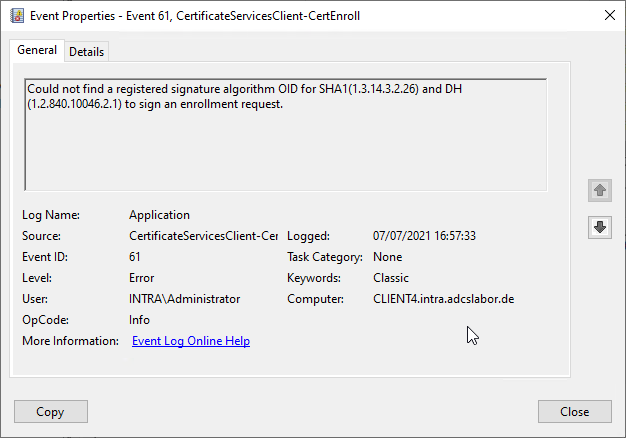
Description
Do you know TameMyCerts? TameMyCerts is an add-on for the Microsoft certification authority (Active Directory Certificate Services). It extends the function of the certification authority and enables the application of rule sets to realize the secure automation of certificate issuance. TameMyCerts is unique in the Microsoft ecosystem, has already proven itself in countless companies around the world and is available under a free license. It can be downloaded via GitHub and used free of charge. Professional maintenance is also offered.
No description has been written for this yet.
Security assessment
The security assessment is based on the three dimensions of confidentiality, integrity and availability.
No description has been written for this yet.