
Combining Online Responder (OCSP) with delta CRL and CRL distribution point (CDP) without delta CRL for increased resilience
OCSP responses from a Microsoft OCSP responder are valid for exactly as long as the underlying certificate revocation list (CRL). In some scenarios, you may want to reduce OCSP validity times by using delta CRLs. At the same time, however, no delta CRL should be used for the CRLs entered in the CDP paths in order to enable a fallback to a CRL with a longer validity.
The Online Responder (Online Certificate Status Protocol, OCSP) is an alternative way of providing revocation status information for certificates. Thanks to OCSP, entities that want to check the revocation status of a certificate do not have to download the complete list of all revoked certificates, but can make a specific request for the certificate in question to the Online Responder. For a more detailed description, see the article "Basics: Online Responder (Online Certificate Status Protocol, OCSP) ".
The configuration described here works in practice, but has not been tested by the manufacturer (Microsoft) and is therefore not officially supported.
Certification Authority Configuration: Registration
Do you know TameMyCerts? TameMyCerts is an add-on for the Microsoft certification authority (Active Directory Certificate Services). It extends the function of the certification authority and enables the application of rule sets to realize the secure automation of certificate issuance. TameMyCerts is unique in the Microsoft ecosystem, has already proven itself in countless companies around the world and is available under a free license. It can be downloaded via GitHub and used free of charge. Professional maintenance is also offered.
Delta CRLs must be enabled on the CA.

Certification Authority Configuration: Extensions
The option "Include in CRLs. Clients use this to find Delta CRL locations." must be disabled for each published (LDAP or HTTP) CDP path so that the CRL does not contain a "Freshest CRL" extension.
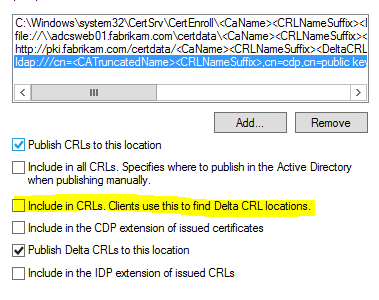
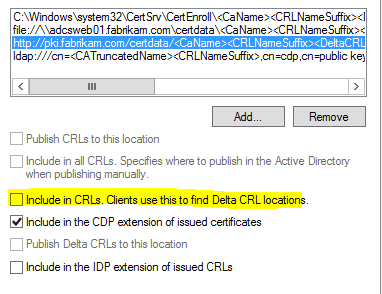
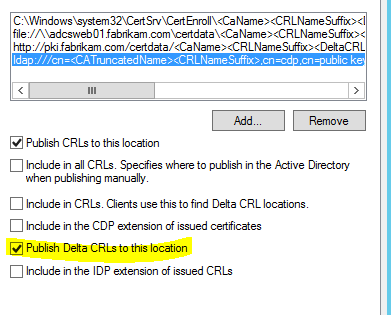
However, at the same time you enable the "Publish Delta CRLs to this location" function on the locations for CDP (LDAP or File).
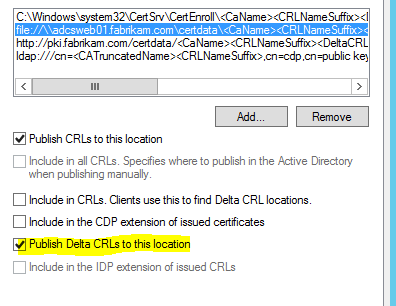
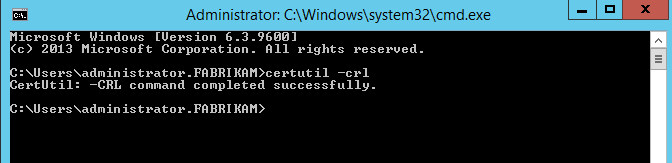
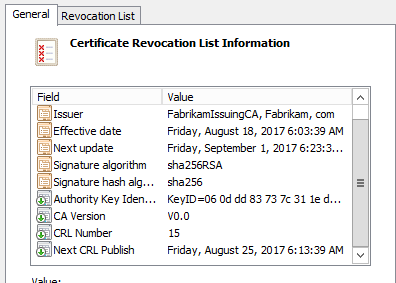
The CA service must be restarted once after the change. A delta CRL must then be generated by publishing a new CRL.
The Base CRL should not include a "Freshest CRL" extension.
Configuration OCSP Responder
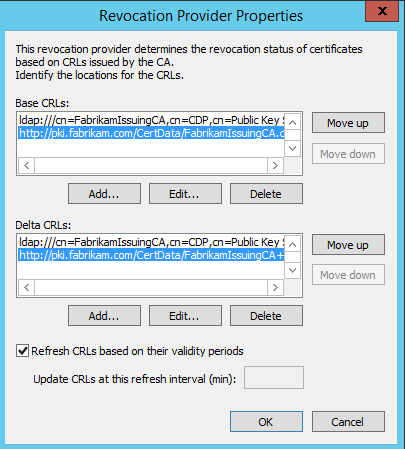
The revocation providers must now be filled manually on the OCSP responder, since the base CRLs deliberately contain no reference to the delta CRL.
Example
Base CRL
- ldap:///cn=FabrikamIssuingCA,cn=CDP,cn=Public Key Services,CN=services,CN=Configuration,DC=Fabrikam,DC=com?certificateRevocationList?base?objectClass=cRLDistributionPoint
- http://pki.fabrikam.com/CertData/FabrikamIssuingCA **.crl**
Delta CRL
- ldap:///cn=FabrikamIssuingCA,cn=CDP,cn=Public Key Services,CN=services,CN=Configuration,DC=Fabrikam,DC=com?deltaRevocationList?base?objectClass=cRLDistributionPoint
- http://pki.fabrikam.com/CertData/FabrikamIssuingCA **+.crl**
If the Delta CRL should expire, CAPI2 will fall back to the Base CRL.
----------------  Certificate AIA  ----------------
   Verified "Certificate (0)" Time: 0
     [0.0] http://pki.fabrikam.com/certdata/FabrikamIssuingCA.crt

   Verified "Certificate (0)" Time: 0
     [1.0] ldap:///cn=FabrikamIssuingCA,cn=aia,cn=public%20key%20services,cn=services,CN=Configuration,DC=Fabrikam,DC=com?cACertificate?base?objectClass=certificationAuthority

   ----------------  Certificate CDP  ----------------
   Verified "Base CRL (1c)" Time: 0
     [0.0] http://pki.fabrikam.com/certdata/FabrikamIssuingCA.crl

   Verified "Base CRL (1c)" Time: 0
     [1.0] ldap:///cn=FabrikamIssuingCA,cn=cdp,cn=public%20key%20services,cn=services,CN=Configuration,DC=Fabrikam,DC=com?certificateRevocationList?base?objectClass=cRLDistributionPoint

   ----------------  Base CRL CDP  ----------------
   No URLs "None" Time: 0
   ----------------  Certificate OCSP  ----------------
   Expired "OCSP" Time: 0
     [0.0] http://ocsp.fabrikam.com/ocsp

 […]

 Verified Issuance Policies: All
 Verified Application Policies:
     1.3.6.1.4.1.311.21.5 Private Key Archival
 Leaf certificate revocation check passed
 CertUtil: -verify command completed successfully